
Saint-Gobain Glass has been shortlisted in four categories at the Glass Focus Awards 2026, recognising its commitment to product innovation, sustainability, higher-performance1 architectural glazing and the development of future industry leaders.
The company has been named a finalist in the Innovative Solutions category for its 4.8mm STADIP® PLUS laminated safety and security glass, the Sustainable Practice category for PLANICLEAR® lower-carbon glass, and the Design of the Year – Flat Glass category for the glazing elements at the Stoke-on-Trent and Staffordshire Institute of Technology (IoT) hub at Stafford College. While Production Operations Manager Sophie Higgs has been shortlisted for a Rising Star award.
Mike Butterick, Marketing Director at Saint-Gobain Glass said: “Being shortlisted for four Glass Focus Awards reflects the breadth of our work across the glazing sector, from developing products that help manufacturers meet increasingly demanding performance requirements to embedding lower-carbon practices into mainstream production and supporting the people who are shaping the industry’s future.
“The nominations demonstrate the role of glass in delivering more energy-efficient buildings, reducing environmental impact and creating inspiring spaces, while highlighting the technical expertise and collaborative partnerships that make these advances possible.”
The nomination for Innovative Solution recognises 4.8mm STADIP® PLUS, a thinner2, lighter2 laminated safety and security glass developed to help manufacturers optimise glazing performances without compromising recognised P2A3 safety and security performance.
Traditionally, achieving P2A3 laminated glazing performance has required thicker, heavier constructions, potentially creating challenges for handling, installation, window hardware and the optimisation of insulated glass units. By reducing the laminate thickness to just 4.8mm, STADIP® PLUS maintains recognised P2A3 security classification under EN 356 while creating additional space for insulating cavities within standard double- and triple-glazed units.
This additional flexibility can deliver measurable thermal improvements. For example, replacing a 6.8mm STADIP® laminate with 4.8mm STADIP® PLUS in a standard 24mm double-glazed unit, incorporating PLANITHERM® NEO (face 34) and a 90% argon-filled cavity, can improve the centre-pane U-value from 1.1 W/m2.K to 1.0 W/m².K5.
The reduced weight2 of 4.8mm STADIP® PLUS product can also offer practical benefits throughout the supply chain, including the potential to make processing, handling, transportation and installation more straightforward when compared to heavier equivalent products. The product can also help to achieve enhanced acoustic performance6 and the potential for increased light transmission7 in selected configurations.
Manufactured in the UK using lower-carbon PLANICLEAR® glass8, 4.8mm STADIP® PLUS combines technical innovation with a reduced-material approach. Its potential is particularly significant as the adoption of triple-glazing has the potential to grow, and the industry may further seek to balance energy efficiency, security, weight and ease of installation.
Saint-Gobain Glass’s second nomination, in the Sustainable Practice Award category, recognises the progress made with PLANICLEAR®, demonstrating how lower-carbon glass can become a standard specification choice rather than a specialist alternative.
The latest independently verified Environmental Product Declaration (EPD) for 4mm PLANICLEAR® records a Global Warming Potential of 7.22 kgCO₂e/m² across product life-cycle stages A1–A3. This represents a reduction of more than 34% against the previous declared figure.
The improvement has been achieved through ongoing decarbonisation efforts and circular manufacturing initiatives at Saint-Gobain Glass’s Eggborough plant, supported by its wider Glass Forever programme, with PLANICLEAR® incorporating 6.82% post-consumer recycled glass content.
Crucially, the lower-carbon glass remains a standard product, with no compromise on quality or performance. This enables fabricators, processors, specifiers and construction professionals to reduce the embodied carbon of their glazing solutions without changing established product specifications.
With new EPDs available across the PLANICLEAR® thickness range, as well as Sapphire Blue, the initiative also gives customers greater access to independently verified environmental data to support procurement decisions, project assessments and sustainability reporting.
By embedding carbon reduction into everyday production, Saint-Gobain Glass is demonstrating how manufacturing improvements can deliver environmental benefits at scale across the construction supply chain.
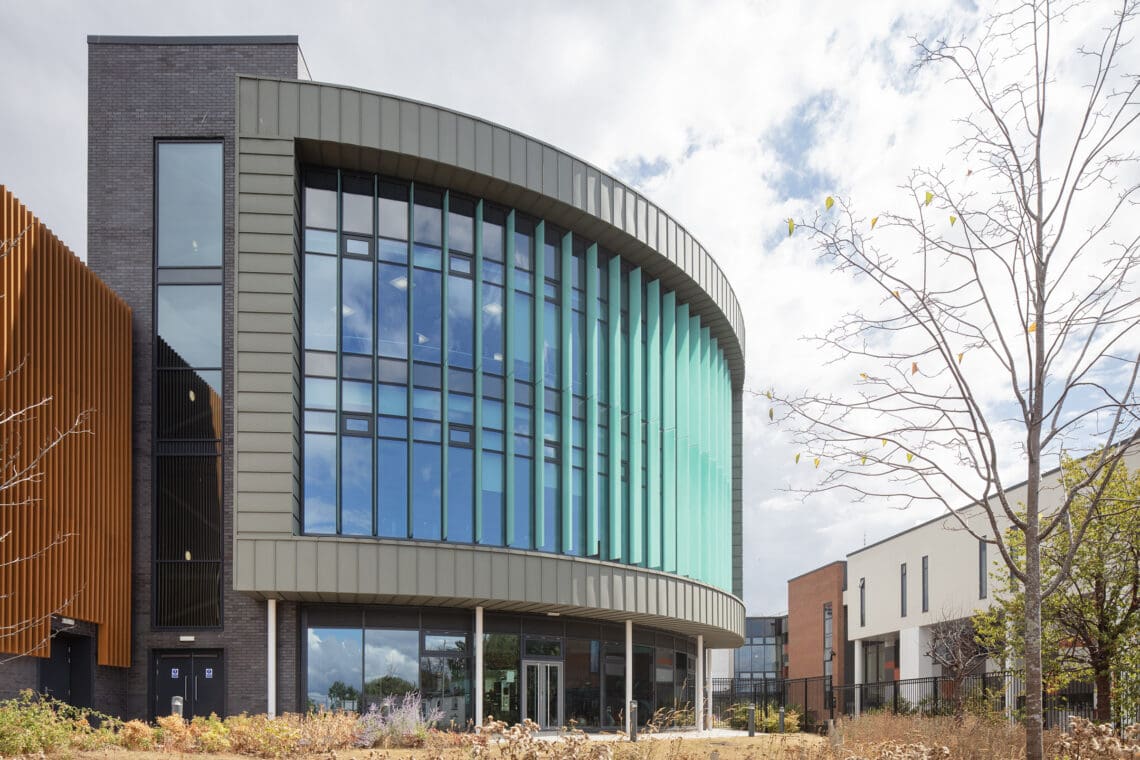
The nomination for Design of the Year – Flat Glass recognises the Stoke-on-Trent and Staffordshire Institute of Technology hub at Stafford College, a £22.5 million educational development designed to inspire the next generation of engineers, scientists and digital innovators.
The three-storey, BREEAM® Excellent building brings together specialist facilities for advanced manufacturing, engineering, health sciences, sustainability and digital technology. Its extensive glazed façade plays a central role in creating a contemporary, light-filled learning environment, while supporting the building’s wider energy-efficiency objectives.
Saint-Gobain Glass supplied 1,000m² of COOL-LITE® XTREME 70/33 II, a higher-performance solar control glass that combines high light transmission with effective control of unwanted solar heat gain. With a selectivity of 2.12, the glass helps balance daylight, occupant comfort and thermal performance without compromising the building’s clean, modern architectural appearance.
The glazing was incorporated into a Tental curtain wall system as part of a coordinated design and delivery process involving Ellis Williams Architects, main contractor Speller Metcalf, façade specialist Quality Glass and glass processor Euroview.
The result demonstrates how the intelligent specification of flat glass can support both architectural ambition and environmental performance. By maximising natural light while limiting solar heat gain, the façade contributes to a comfortable environment for learning and collaboration, complementing the building’s wider sustainability measures.
The project also forms part of the wider Stafford Station Gateway regeneration, bringing a technology-led educational facility to a previously developed site and providing students with a real-world example of innovative building design.
Completing the four nominations is Sophie Higgs, shortlisted for the Rising Star award in recognition of her engineering expertise, operational leadership and commitment to professional development.
Sophie joined Saint-Gobain Glass in 2025 as a Process and Product Development Engineer within the Coater Technical Team, contributing to the development of new products including COOL-LITE® XTREME 70/33 II with BIOCLEAN II and PLANITHERM® NEO.
She moved into the role of Production Operations Manager in August 2026, taking responsibility for developing shift teams, managing health, safety and environmental performance, maintaining quality standards and driving operational improvements through World Class Manufacturing (WCM) activities.
Sophie brings a strong technical and manufacturing background to the role. She holds a first-class MEng in Chemical and Process Engineering from the University of Leeds and has previously worked in the chemical and building materials sectors, progressing from process engineering into production management. During this time, she gained Green and Black Belt qualifications in Lean Six Sigma, developing expertise in continuous improvement, product development and capital projects.
More recently, she achieved the NEBOSH Level 6 National Diploma for Occupational Health and Safety Management Professionals, further strengthening her contribution to safe and effective manufacturing operations.
Her nomination highlights the importance of developing skilled people who can combine technical knowledge, operational experience and leadership to support the continued evolution of the glass industry.
The four nominations demonstrate how Saint-Gobain Glass is addressing some of the glazing industry’s most pressing challenges, from improving thermal efficiency and reducing embodied carbon to delivering higher-performance building façades and investing in the next generation of manufacturing talent.
The Glass Focus Awards 2026 are organised by industry body British Glass. Winners will be announced at an awards dinner on Thursday 19 November 2026 at the voco Sheffield by IHG.
References
- Higher performance, coated, flat glass, achieves an emissivity level of 3% or less. Saint-Gobain Glass’ PLANITHERM® and COOL-LITE® products are higher performing than uncoated, flat glass substrates, based on emissivity level.
- Compared to 6.8mm STADIP® laminate glass.
- P2A is a recognised classification under EN 356 for security glazing. To achieve this rating, the glass must resist three repeated impacts from a 4.11kg steel sphere dropped from a height of 3 metres.
- In a standard double-glazed unit (DGU) there are four potential surfaces to which coatings can be applied: surface 1 faces outdoors, surface 2 and surface 3 face each other inside the DGU, separated by a peripheral spacer which creates an insulating air space, and surface 4 faces directly indoors.
- 8mm STADIP® PLUS/16mm cavity, 90% argon/4mm PLANITHERM® NEO (face 3) with a U-value of 1.0 W/m2.K, when compared with 6.8mm STADIP®/14mm cavity, 90% argon/4mm PLANITHERM® NEO (face 3) with a U-value of 1.1 W/m2.K.
- Comparing 4(16mm cavity, 90% argon) 4.8mm STADIP® PLUS with a Calumen simulated Rw of 34 (-1; -5) dB, with 4(16mm cavity, 90% argon)4 with a simulated Rw of 31 (-1; -4) dB.
- Comparing 4.8mm STADIP® PLUS (16mm cavity, 90% argon) 4mm PLANITHERM TOTAL+ (face 3) with a light transmittance of 79%, with a 6.8mm STADIP® (14mm cavity, 90% argon) 4mm PLANITHERM TOTAL+ (face 3) with a light transmittance of 78%.
- EPD – environdec.com.


